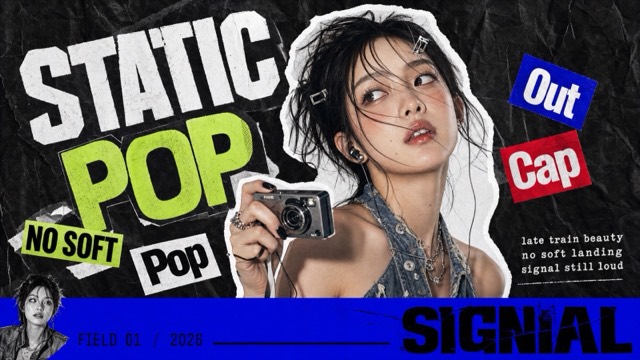
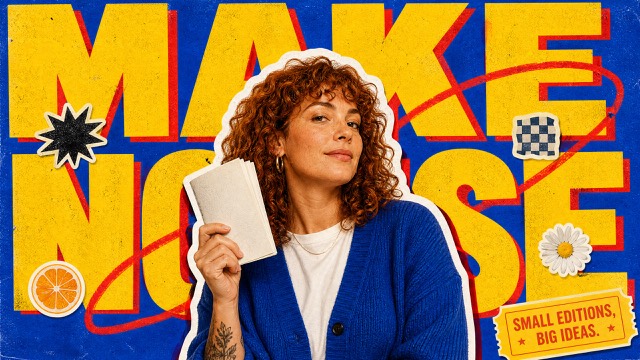
Zine + Collage
Acid Jolt Portrait Collage
A punchy portrait-poster system mixing warm, low-fi close-up photography, blunt photo-fragment inserts, massive lemon-yellow rounded lettering, and loose marker signals against dark, quiet fields.
Images are AI-generated with this style's prompt. Your results will vary by model and the details you enter.
Build your prompt
Fill in the details below, or leave them blank and the AI will choose what fits the style. Prompts stay in English because image models understand it best; the text you want shown on the image can be in any language.
Gemini and some tools cannot take a prompt from a link, so press Copy prompt first, then paste.
Full style rules
Style anchors
- [CORE] Build the image around a large, close, warm-toned photographic portrait or human detail, with realistic peach, coral, and brown skin against a much darker, muted field.
- [CORE] Use a small number of deliberately blunt rectangular or trapezoid photo fragments, visibly layered across or beside the main photo; the inserts may isolate a face detail, hand, clothing, or case-relevant prop without repeating one fixed anatomy layout.
- [CORE] Make one short all-caps headline visually dominant in thick, rounded, tightly spaced sans-serif letters, usually lemon or acid yellow; let the type press into the photo layers while keeping the complete wording readable.
- [CORE] Hold a stark warm-light / dark-field / acid-yellow contrast, with yellow reserved for the headline and a few hand-drawn graphic accents.
- [CORE] Add one or two loose, hand-marked yellow strokes or simple signals that interact with the subject's gesture or theme; keep them irregular and editorial, not a dense technical interface.
- [CORE] Preserve an intentionally low-fi photographic finish: visible grain or compression texture, slight softness, uneven flash-lit tonal transitions, and crisp collage boundaries where fragments overlap.
- [FLEX] Recompose the portrait, headline, photo inserts, and marker strokes for the case and canvas ratio; explore asymmetric scale, cropping, stacking, or diagonal movement without reproducing the source's exact positions.
- [FLEX] Keep secondary copy small and peripheral, and use open negative space wherever the headline and case-relevant action need clarity.
Do
- Give each case a distinct visual idea that changes how the subject, title, and cutout fragments interact.
- Render the supplied headline and secondary line exactly, with the headline as the first read.
- Keep the final image graphic and poster-like, with visible photographic layering and limited yellow annotation.
Avoid
- Do not reproduce the reference person, exact face-fragment arrangement, exact phrase, or exact layout.
- Do not make every case a centered beauty portrait with the same eye strips and lettering across the eyes.
- Do not obscure the whole face, essential action, or required prop with unreadable foreground type.
- Do not introduce brand logos, watermarks, dense interface graphics, clean vector-only art, glossy 3D styling, or a polished luxury-ad finish.
- Do not add extra legible copy beyond the supplied main and secondary text.
Negative prompt
the source person's identity, POP, original footer text, duplicated eye strips, polygon mouth crop, exact source layout, exact upper-left zigzag, repeated face-centered template, unreadable headline, misspelled required text, extra pseudo-copy, obscured action, obscured essential prop, brand mark, watermark, QR code, app interface, dense technical rails, monochrome-only treatment, clean vector-only poster, glossy 3D render, luxury beauty advertising, heavy grunge, random glitch effects, rainbow palette, unrelated props