Product + Campaign
Vector Process Study
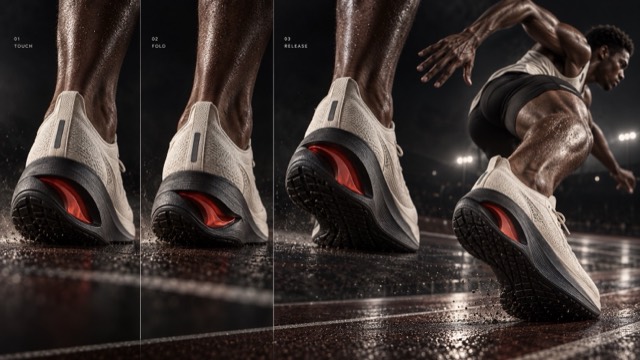
Premium footwear process boards explain load, flex, fit and construction through sequential image panels, tactile material macros, sparse micro-labels and a distinct sculptural shoe architecture.
Images are AI-generated with this style's prompt. Your results will vary by model and the details you enter.
Build your prompt
Fill in the details below, or leave them blank and the AI will choose what fits the style. Prompts stay in English because image models understand it best; the text you want shown on the image can be in any language.
Gemini and some tools cannot take a prompt from a link, so press Copy prompt first, then paste.
Full style rules
Style anchors
- [CORE] Tell one clear product process from left to right or top to bottom using three or four sequential panels; physical change between stages must be visible.
- [CORE] Use a distinct unbranded trainer: pearl-bone knit upper, open heel cage, brushed-titanium floating arch bridge, one continuous smoked-ceramic rocker with three long carved channels and a smooth integrated forefoot.
- [CORE] Make the process legible with side views, cross-sections, material macros, understated arrows and consistent stage spacing; prioritize explanation over a heroic portrait.
- [CORE] Premium material realism: individual knit fibers, brushed titanium grain, satin ceramic, soft stone and accurate contact shadows under sculptural studio light.
- [CORE] Keep typography exceptionally sparse and small: only hairline step numbers and short process labels, aligned to panel edges; no large display title or decorative headline.
- [CORE] Use obsidian, warm bone, brushed titanium and pearl gray; glacial-cyan appears only as a fine directional mark or state-change highlight.
- [FLEX] Vary stage sequence and panel geometry by process while keeping the footwear construction, material palette and micro-label scale consistent.
- [FLEX] Compose portrait and landscape independently so the stages remain legible and in correct order; never solve one ratio by cropping the other.
Do
- Show the same product at comparable angles when depicting before, during and after states.
- Use one or two restrained arrows or fine connectors to clarify process direction.
- Make the product's material and structural changes visible at macro scale.
Avoid
- Hero portraits that occupy most of the board while the process is hidden.
- Large headlines, large slogans, chunky numbers, crowded labels or fake paragraphs.
- Copied reference shoe, repeated round sole pods, red outsole, brand marks or loud neon.
Negative prompt
No large typography, oversized headline, decorative slogan, dense paragraphs, copied source shoe, repeated circular pods, bright-red outsole, logos, swooshes, trademarks, exact reference collage, giant athlete portrait, crowded HUD, glowing sci-fi circuits, loud neon, malformed anatomy, duplicate shoes, unreadable process order, inaccurate cutaway, plasticky knit, low-resolution texture.