Editorial + Minimal
Crimson Vanishing Point Editorial
A high-pressure editorial-poster system that turns a monochrome, ultra-wide one-point-perspective public interior into a typographic corridor. A lone central figure moves away from the viewer as enormous scarlet letters become receding floor, wall, and ceiling planes, while blurred peripheral bodies and faint technical text create urgency without clutter.
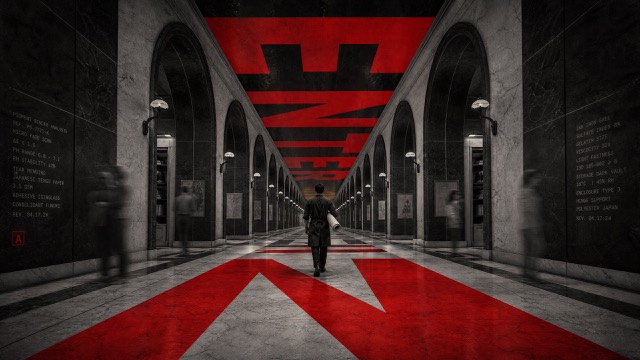
Images are AI-generated with this style's prompt. Your results will vary by model and the details you enter.
Build your prompt
Fill in the details below, or leave them blank and the AI will choose what fits the style. Prompts stay in English because image models understand it best; the text you want shown on the image can be in any language.
Gemini and some tools cannot take a prompt from a link, so press Copy prompt first, then paste.
Full style rules
Style anchors
- Use a strongly centered one-point perspective inside a long monumental public interior, with repeated bays, arches, ceiling ribs, or light fixtures converging at a single deep vanishing point.
- Render the architecture almost entirely in high-contrast black, white, and silver-gray, with coarse photographic grain and a slightly documentary, low-light feel.
- Place one lone adult figure on the central axis, walking away or moving forward into the depth of the corridor, with the body read primarily as a dark silhouette.
- Keep the central figure smaller than the architecture and typography, approximately 15–25% of canvas height, so the space and word planes dominate the drama.
- Add one to three enormous scarlet-red uppercase word fragments or geometric letter planes aligned to the exact vanishing-point perspective, appearing on the floor, ceiling, or spanning the central corridor.
- Use large red letter planes nearest the viewer and progressively smaller red fragments as they recede toward the vanishing point; they must be dimensional perspective objects, not a flat title pasted over the scene.
- Include peripheral passersby only as soft motion-blurred gray silhouettes near the side walls, leaving the center axis clear and focused.
- Place sparse, faint off-white or gray technical microtext clusters at the lower side walls or mid-distance, like fragmented archival captions rather than readable body copy.
- Maintain a deliberately limited palette: grayscale architectural photography plus one high-purity scarlet-red accent only; no additional bright colors.
- Use hard editorial contrast, slightly vignetted corners, lens-like distortion, and a sense of forward momentum, surveillance, or determined passage.
- Keep the typography blunt and uppercase, with broad geometric letterforms that can be cropped by the frame and the architectural perspective.
Do
- Use monochrome ultra-wide perspective, a small dark central figure, scarlet typographic planes, and soft peripheral movement.
- Create a coherent shared vanishing point for architecture, red letter forms, floor, and ceiling.
- Use grain, vignetting, and faint technical text to create a tense editorial-documentary atmosphere.
Avoid
- Do not recreate the source subway station, businessman, briefcase, giant word, original red-plane arrangement, or source caption text.
- Do not flatten the red type across the photo, introduce more bright colors, or use a clean corporate stock-photo treatment.
- Do not fill the center with a crowd, add logos/signage, show a recognizable real transit location, or use dense readable paragraphs.
Negative prompt
No original subway, no platform, no transit signage, no man in black suit, no briefcase, no source giant word or glyph sequence, no source prose, no exact tunnel geometry, no logo, no watermark, no QR code, no readable real location sign, no blue/yellow/green/orange/purple, no multicolor neon, no flat red title pasted over photo, no center crowd, no glossy stock image, no weak perspective, no distorted body, and no illegible headline.